
Migrating Destine Broker to Microsoft


About the Client
DESTINE BROKER is one of the largest insurance brokers in Romania and part of the DESTINE HOLDING group, alongside companies such as DESTINE HOLIDAYS, DESTINE LEASING IFN, DESTINE CREDITE and DESTINE IMOBILIARE.
Founded in 2007, the company has consistently ranked among the top insurance brokers in Romania in terms of annual revenue and the volume of issued insurance policies.
Recognized as one of the most technologically advanced and innovation-driven insurance brokers in the local market, DESTINE BROKER continuously invests in modern digital solutions and infrastructure. This long-term technology-oriented vision has played a key role in building a scalable, efficient, and future-ready organization designed for sustainable growth.
The Challenge
As the company grew to mediate €300M in insurance policies annually, its IT infrastructure, communication, and organizational policies faced major challenges.
With one of Romania’s largest sales forces, comprised of over 8,000 professionals, the need for a scalable, efficient system was critical.
Key challenges included:
- 80% of communication relied on emails, with some users handling 2,500+ emails daily on an outdated IMAP/POP3/SMTP system.
- No centralized user and policy control or cloud infrastructure for remote work.
- File sharing was limited to email attachments.
- Weak security due to infrastructure, user conduct and policy gaps.
- No previous cloud tools adoption within the company’s structure.
- A two-year transition period required seamless parallel infrastructures, with HQ shifting to a new domain while others remained on the old one.
- Migration to Microsoft’s infrastructure had to be done in steps: First phase – 100 users, Second phase – 1400 users, Third phase – approximately 7000 users.

Technologies
The Approach
Following multiple stakeholder meetings, we gained a deeper understanding of the client’s need for a dynamic and scalable infrastructure capable of supporting both daily operational challenges and future business growth.
Throughout these discussions, we also identified Destine Broker’s increasing focus on enhanced IT security, stricter user access policies, and improved operational control.
In addition, we addressed the need for a more efficient communication and collaboration flow between the companies within the group.
When working with large organizations, understanding how departments are structured, interconnected, and impacted by infrastructure changes is essential to maintaining operational continuity and business efficiency.
Define the company structure
In order to establish a well planned approach we had to first understand Destine’s department structure and the connection it has with other companies from its structure.
We were provided with documents and an updated department hierarchy that allowed us to better understand how their employees work and how departments are structured and will be formed in the future.
An analysis was also conducted to determine how Destine Broker communicates and shares information across the industry and within the parent organization, Destine Holding, in relation to the other companies in the group.
Assessing Current Capabilities & Infrastructure
At this stage, we collaborated closely with the stakeholders and Destine’s IT department to evaluate the performance of the existing infrastructure, identify operational limitations, and define a projected budget for the planned infrastructure upgrade.
To support long-term organizational efficiency, we also discussed future training initiatives and software development requirements aimed at ensuring scalability, operational continuity, and a smooth transition throughout the modernization process.
A 5-Year Expansion Strategy
This stage was essential in identifying the most suitable IT solutions for Destine Broker’s long-term development objectives.
Our approach focused on designing a dynamic and scalable infrastructure capable of supporting continuous business growth without requiring major architectural changes in the future.
Together with the client, we projected the company’s operational expansion, anticipated user growth, and evaluated the evolving technological requirements for the next five years.
We also analyzed critical areas such as enhanced cybersecurity, centralized policy management, and the implementation of scalable organizational standards designed to support a secure, efficient, and future-ready IT ecosystem.
Defining Key Areas for Infrastructure Restructuring
The final stage focused on identifying the critical areas that required restructuring and establishing preliminary implementation timelines for each phase of the modernization process.
Every operational area presented its own technical and organizational challenges, requiring a carefully planned approach to ensure that the selected solutions addressed both current limitations and future scalability requirements.
Our objective was to create a structured, efficient, and sustainable transformation roadmap aligned with Destine Broker’s long-term business and infrastructure goals.
Key Factors
Workflows & Processes
Understanding the company’s operational workflows and internal working processes represented a critical factor in defining and implementing the appropriate technical solution.
Current Capabilities
Software products can only be successfully implemented based on a company’s technical and organizational capabilities.
Data Governence
The processing and governance of critical data within financial or insurance companies must always be approached as a top priority.
Company Expansion
Any proposed IT approach must be aligned with a company’s 3–5 year expansion strategy and long-term business objectives.
The Solution
Following a two-month data gathering and evaluation process, our team was prepared to propose the most suitable IT solution for Destine Broker’s long-term operational and business objectives.
The proposed strategy took into account the capabilities and limitations of the existing infrastructure, the company’s projected expansion plans, the growing need for improved communication and collaboration, as well as the increasing importance of advanced cybersecurity and centralized management.
After carefully analyzing the available options, we concluded that transitioning to a Microsoft Infrastructure represented the most efficient, scalable, and secure solution for the organization.
We subsequently moved forward with planning the required Microsoft licensing structure for the company’s users, identifying the necessary add-ons and services, estimating implementation costs, and projecting the operational and financial investment required over the following five years.

Technical Planning & Transformation Timeline
Our team developed a comprehensive implementation plan designed to provide a clear structure for the entire digital transformation journey, including a projected six-month timeline for the migration to Microsoft’s infrastructure and ecosystem.
Throughout the planning phase, we carefully addressed one of the project’s most significant challenges — the coexistence of multiple infrastructures during a two-year hybrid operational period required by the client.
This approach ensured business continuity while allowing a gradual and controlled transition to the new environment.
The transformation roadmap was scheduled to begin in November 2023, with the primary implementation deadline planned for April 2024.
For the first 100 users within Destine Broker’s headquarters, the team projected June 2024 as the target date for the complete transition to Microsoft’s infrastructure and the gradual retirement of the legacy systems previously in use.
Infrastructure development
During the second step we created the necessary adoption documents and presentations, we set a few approval meetings with the stakeholders, and we began on creating the actual Microsoft infrastructure.
We developed their Microsoft Tenant, assigned access and created the user database. Our team created 20 SharePoint sites and more than 50 teams and channels on Teams, all with the appropriate user permissions and files structure.
For Microsoft Exchange, we handled additional licensing, permissions, archiving policies, auto-archiving, and shared mailboxes. Email retention was customized per department.
We’ve applied the necessary security and organizational policies within MAC, Microsoft Entra ID and Microsoft Defender. Additionally, we prepared training documentation to review with their employees.
User Implementation and Data Migration
Now that we had most of the infrastructure in place, it was time to handle the user’s access to the new infrastructure.
Our team configured employee devices during on-site workdays, deployed Office 365 products, Teams, SharePoint mapping, and OneDrive.
We implemented RPA flows for four departments, enhancing efficiency and security.
Migrating 3.2TB of email data from on-premises to Exchange, including domain transitions, was a challenge but completed smoothly over three weeks.
Testing & Multi-Phase Deployment for Destine Broker Employees
The quality assurance and testing process was carried out incrementally, with every implementation stage carefully analyzed and validated across multiple operational scenarios.
To ensure a smooth and controlled transition, the digital transformation initiative was deployed through a multi-phase rollout strategy, allowing employees to gradually test and adapt to each Microsoft solution introduced within the new infrastructure.
Testing activities were conducted using small pilot groups of up to three representatives from each department, where real-world operational workflows and use cases were simulated in detail.
All collected feedback, performance data, and operational observations were centralized and continuously reviewed by our team, enabling us to optimize configurations, refine integrations, and ensure seamless connectivity across the entire ecosystem.
Transitioning Daily Operations to the New Infrastructure
Following the successful completion of the quality assurance process and final stakeholder validation, we gradually transitioned the company’s daily operational activities to the newly implemented infrastructure.
Throughout the deployment phase, our team continuously monitored system usage, file management processes, spam and filtering mechanisms, data sharing activities, and user access policies across the entire ecosystem to ensure operational stability and security.
Detailed operational reports were generated and subsequently reviewed during status meetings held at Destine Broker’s headquarters, allowing all stakeholders to evaluate performance, address observations, and ensure a smooth organizational transition.
Organizational Training & Technical Support
The final phase of the project focused on ensuring long-term adoption and operational continuity through continuous employee training delivered over a two-year period, in addition to the pre-implementation sessions provided by our team.
Specialized training for Microsoft solutions such as SharePoint, Teams, Power Automate (RPA), and OneDrive played an essential role in increasing product adoption, improving collaboration, and maximizing organizational efficiency across departments.
Alongside the training process, our team provided — and continues to provide — dedicated technical support for Destine Broker’s departments under a 99.99% SLA framework, ensuring rapid response and operational stability.
The Conclusion
Destine Broker’s digital transformation represented a major organizational milestone, delivering measurable operational improvements and immediate business impact following the transition to Microsoft’s ecosystem.
Key benefits observed during the first 12 months after implementation included:
- Significantly improved email communication and management through Microsoft Exchange, resulting in a 57% increase in email processing efficiency.
- Substantially reduced spam and phishing attempts through Microsoft Defender security policies, with a 78% decrease compared to the previous infrastructure.
- Centralized identity and access management with no reported security breaches, managed through Microsoft Admin Center and Microsoft Entra ID.
- Strong adoption of Microsoft collaboration tools, including SharePoint, OneDrive, and Teams, with platform usage rates ranging between 59% and 75% across the first 100 employees.
- Streamlined user administration processes, including faster onboarding, offboarding, licensing, and account management, reducing the IT department’s operational workload by more than 22%.
- Enhanced security, governance, and compliance capabilities through advanced user control policies, data governance frameworks, Microsoft Defender AI tools, and Microsoft Purview integrations.
Over the first 12 months following implementation, the client reported an overall operational efficiency increase of 18%, with additional improvements expected as the organization continues to expand product adoption and employee training initiatives.
The digital transformation process remains ongoing. As Microsoft continuously introduces new technologies, features, and security capabilities, ongoing integration, optimization, and adoption efforts remain essential to maintaining long-term operational performance and scalability.
Our team will continue monitoring Destine Broker’s progress, optimizing the infrastructure, and sharing further insights throughout the company’s digital transformation journey.
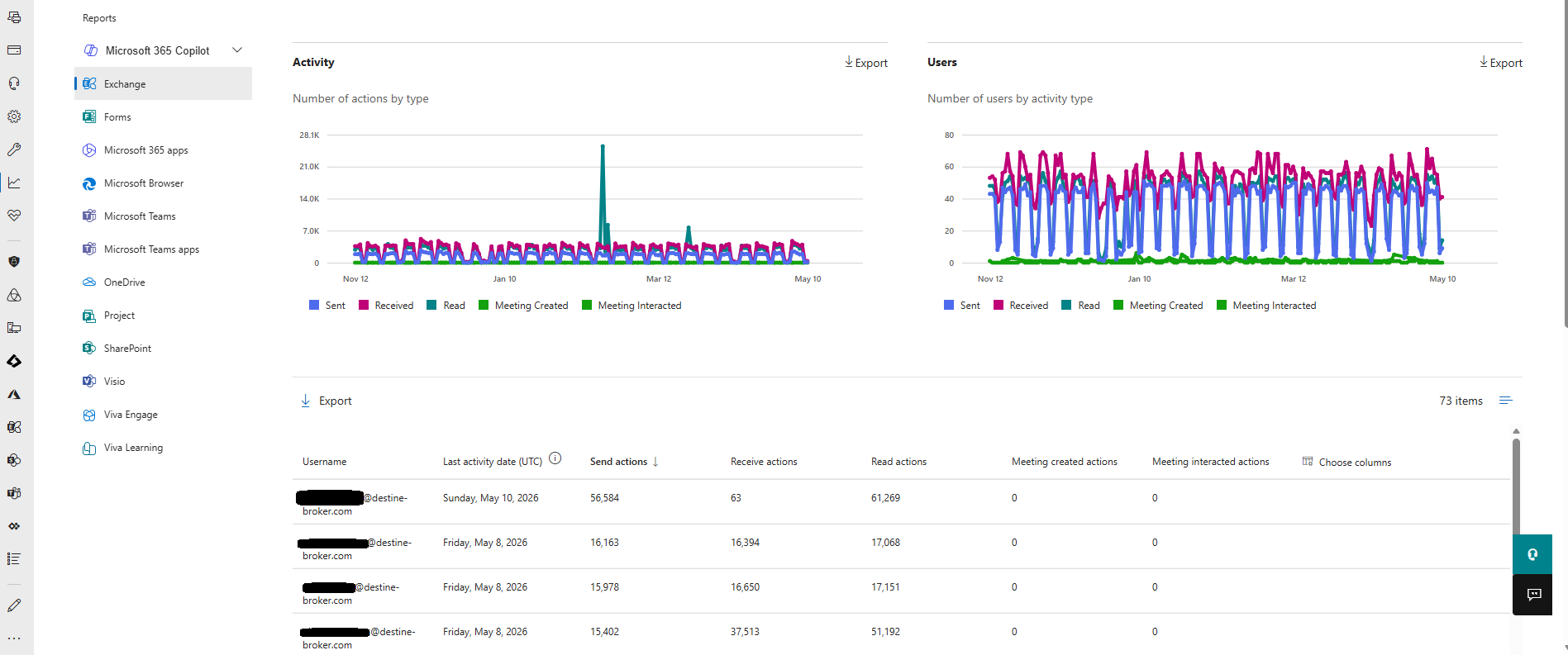
Microsoft Exchange network usage for 180 days
surpasses 4 milion actions ( Send / Receive/ Read) for 73 licensed users.
Acquired services

Marius Laslo
EXECUTIVE DIRECTOR @ DESTINE BROKER
The new websites were received well and helped increase traffic by 80% and revenue by 40%. ZONKWAVE communicated effectively and kept the project moving forward efficiently, while their excellent customer service contributed to the positive experience. Their site was easy to use and intuitive.